
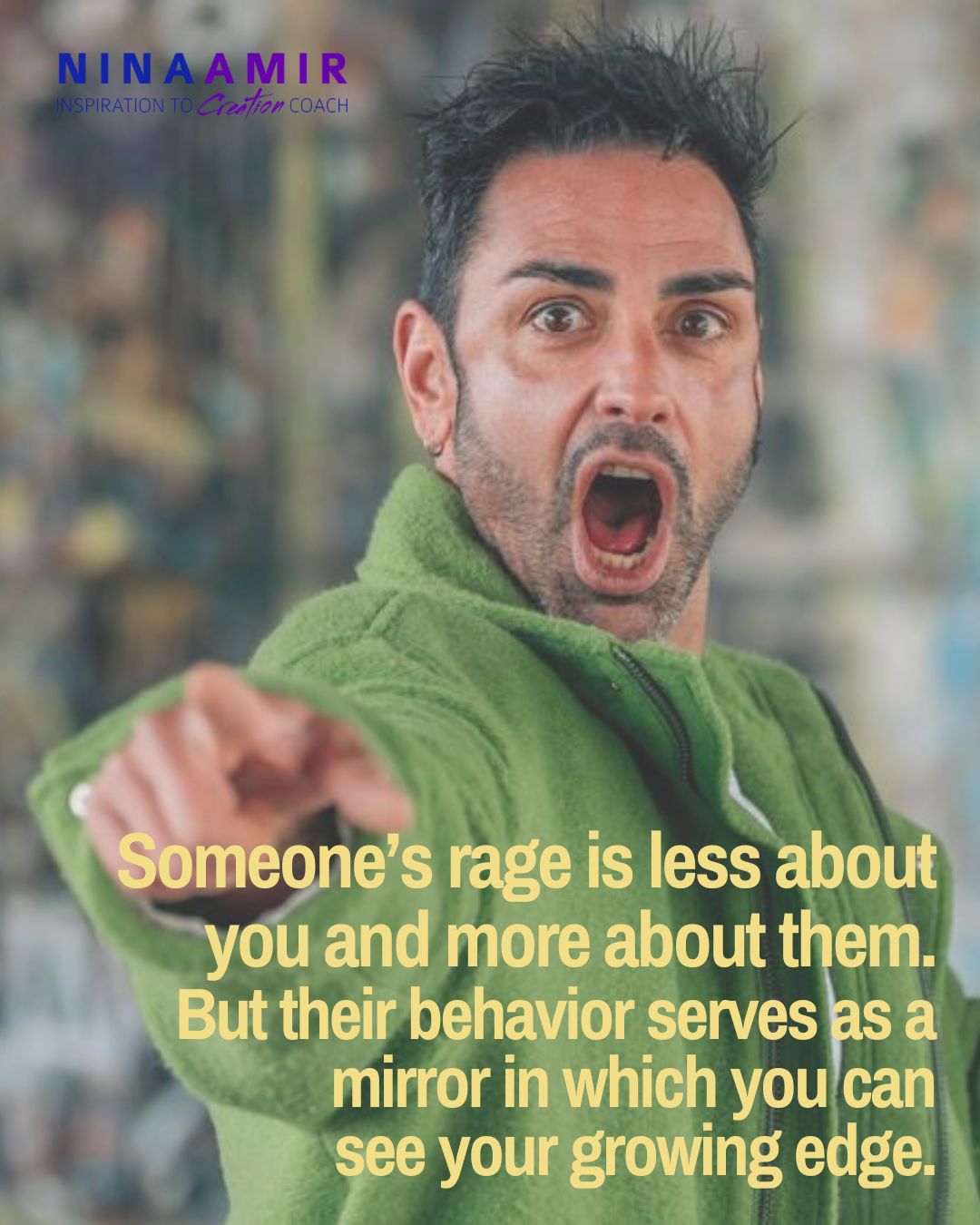
Every experience offers the opportunity to learn lessons and grow personally. Situations serve as mirrors, allowing you to look closely at yourself and discover your growing edge. A recent road-rage incident reminded me of this fact.
Like many of my neighbors, I often walk my dog on a two-lane road near my house that has no sidewalk. It was repaved a few years ago, but the county didn’t accommodate pedestrian needs. And drivers seem to think the newly paved residential street is a highway. They often travel faster than the limit, roll through stop signs, and aren’t considerate of walkers or cyclists.
I admit, I sometimes drive above the speed limit myself. My bad. But, if I see someone walking—especially with a dog—on the side of the road, I slow down and give them a wide berth. I do the same for cyclists. After all, that’s the right thing to do as well as the safest one for all concerned.
Most drivers do the same. And when they do, I wave in thanks. They wave back.
Sometimes, when they don’t, I repeatedly push my hand down in the air instead, indicating that they should slow down when pedestrians and animals are present. Most ignore me.
But not this one guy.
My Encounter with the Road-Rage Guy
I hadn’t walked too far from the stop sign at the intersection of the road on which I live, when a guy in a car came wizzing by and didn’t bother to move out of his lane even a little to give me space. So, I motioned to him to slow down.
At first, he waved at me. Then he realized I had not waved at him. Instead, I had indicated I thought he was doing something wrong—driving too fast.
That was when he slammed on his brakes, opened his car door, and got out. He walked toward me with a cell phone up and (I assume) recording. Then he started to yell at me.
“Why are you telling me to slow down? I was going the speed limit.” Granted, it’s hard to tell if someone is going 30 or 40 mph when you are walking, not driving; maybe he was.
I replied, “Even if you were, you could have just moved over a little bit to give me some more room. There was no one in the other lane, and that’s just courteous and safe.” He hardly heard me as he continued yelling.
“You shouldn’t even be out here on this road walking. I’m going to call the police and tell them what you did. I’ll show them… And why are you lallygagging around and telling me to slow down? Some of us have somewhere to be, somewhere to go.”
He took a few steps toward me. “I’m going to post this video on social media and show everyone what a horrible neighbor you are.”
Just then, a large, black SUV drove up. While it wasn’t a police car, it was a vehicle with a security service emblem on the side and a guard inside. He rolled down the window, and I explained what was going on. He just told me to call the police.
But in the meantime, the Road-Rage Guy must have grown worried, so he got in his car, and drove off.
No Need to be Right
I walked away, a little shaken. But I decided right then that I would no longer tell people in any way, shape, or form to slow down. (There’s even one of my neighbors that I always want to ask to do so, but I haven’t…and won’t.)
My desire to get drivers to slow down (for any reason) is less about them and more about me trying to make them do something I think is right. In the process, I indicate that I believe they are doing something wrong.
And no one likes to be told they’ve done something wrong.
In fact, the need to be right has never gotten anyone anywhere.
Taking Responsibility for Myself
Have you ever gotten angry at someone who pointed out that your behavior could be improved? You blamed them in some way…or made them wrong…rather than owning up to the fact that your behavior could be improved.
This is often called deflection, which is a psychological defense mechanism that involves shifting the blame for a mistake onto someone else to preserve your own self-image.
The Road-Rage Guy likely knew he should have slowed down and yielded to pedestrians and animals. When I pointed it out, he struck out at me rather than taking any responsibility for his own actions. His anger was less about me and more about him.
He wanted to make me wrong, so he could be right.
As he drove off, I decided to take responsibility for myself and my dog. Going forward, I would simply move off the road into the gravel shoulder (or even into a juniper tree, if need be) and give the car and driver the extra space. I wouldn’t demand they move out of my way or slow down.
Blame Shifting in Action
When the Road-Rage Guy accused me of lallygagging, I stopped myself from pointing out that, if he was in such a hurry to get to where he needed to go, he shouldn’t have stopped his car to waste time yelling at me.
Perhaps he had spent the time before our interaction lallygagging. In other words, it’s possible he was in a rush because he wasted time or dawdled rather than getting out of the house in a timely manner, so he wouldn’t have to rush. If that was the case, he exhibited a good deal of blame-shifting when he made me out to be doing the same. Blame shifting is a defense mechanism used to avoid accountability or blaming something or someone for something you did.
That day, I was definitely not wasting time—except during my interaction with the Road-Rage Guy. I had gotten out of the house quickly that morning and headed out to walk the dog a bit earlier than usual. We were moving at a good clip because I needed to get home and begin working. I was focused, effective, and productive.
When the Road-Rage Guy mentioned lallygagging, a term I don’t hear used often, I took a close look in the mirror. I had to admit that there are many mornings when I do waste time and get out the door much later than I would like. And that sets the tone for my entire day. I feel rushed, overwhelmed, stressed, and continually behind or late—and sometimes angry enough to lash out at others. I can definitely develop the habit of being more effective in the morning.
Just Let Them
The final lesson I took away from this experience was to stop trying to control other people’s actions. In the words of Mel Robbins, I decided to “let them.”
In her book, The Let Them Theory, Robbins teaches how to stop wasting energy on what you can’t control or change and start focusing on what truly matters: YOU. This includes your happiness, goals, and life, as well as the need for personal growth.
If I’m honest, at least a few times each week, I allow the drivers who pass me on my morning dog walk to frustrate me. I give them the power to dictate if my walk is peaceful or not. When I can’t control their driving habits, I become angry and unhappy.
I decided that, instead of habitually ruining my walk with my desire to control something I can’t—the drivers —I would just let them drive however they want. I will focus on having a pleasant walk with my dog.
Lessons to Apply
I hope you found the lessons in this post. If not, here they are with corresponding questions you can answer:
- Stop needing to be right. (Would you rather be right or happy?)
- Take responsibility. (Does blaming others or circumstances help you be the type of person who can achieve your goals?)
- Don’t blame shift. (Can you admit to your shortcomings?)
- Let them. (Where do you give away your power—and happiness—to efforts to control people or situations?)
- Every experience is an opportunity for personal growth. (How do you need to change?)
Answer the questions. Apply the lessons. Then see if you don’t become happier and more peaceful…or, at the least, find your growing edge.
Are any of these lessons applicable to you? Tell me in a comment below. Please share this post with those who may benefit from reading it.
Image courtesy of carballo.